WaSABI
MathematicaWaveforms from self-force theory and SF-PN hybrids
PacletInstall["WaSABI"]
Waveforms
Fast, accurate EMRI waveforms on both CPUs and GPUs
pip install fastemriwaveforms
FastEMRIWaveforms (FEW) generates fully relativistic extreme mass-ratio inspiral (EMRI) waveforms quickly enough for LISA data analysis — seconds on a CPU, and faster still on a GPU. The framework is modular: a trajectory module evolves the inspiral, an amplitude module supplies the mode amplitudes, and a summation module assembles the waveform. Modules can be swapped to trade accuracy against speed.
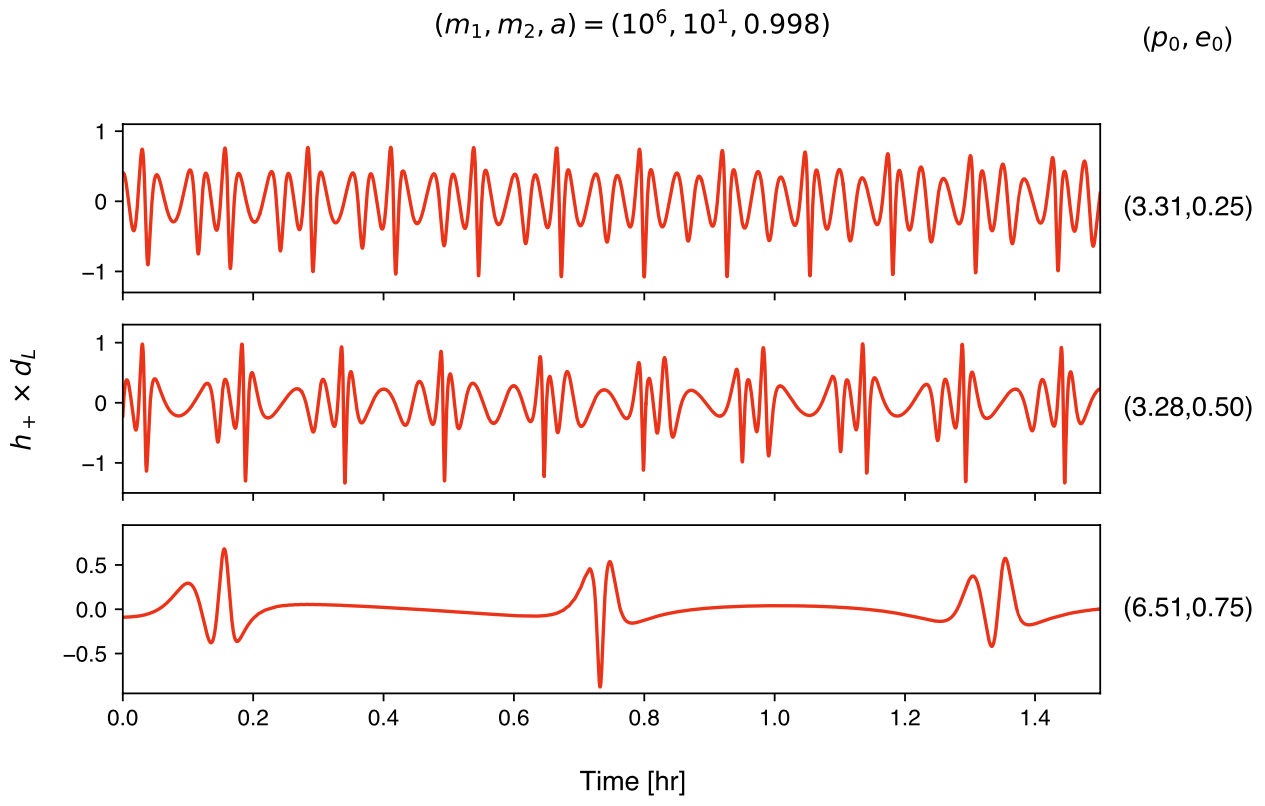
The Kerr eccentric equatorial produces waveforms that faithfully match (slow to generate) reference waveforms with a worst case overlap of $∼10^{−5}$ for inspirals with initial eccentricity $e_0 \le 0.85$. The figure below shows an example of the waveform produced by the model.
The CPU build installs from PyPI:
pip install fastemriwaveforms
GPU acceleration requires a build matched to your CUDA toolkit; see the full documentation for the right package and the supported model names.
Generate a waveform from a high-level model. Parameter names and conventions are detailed in the FEW documentation:
from few.waveform import GenerateEMRIWaveform

wave = GenerateEMRIWaveform("KerrEccEqFlux")

h = wave(
    M=1e6,      # primary mass (solar masses)
    mu=1e1,     # secondary mass (solar masses)
    a=0.5,      # primary spin
    p0=12.0,    # initial semi-latus rectum
    e0=0.3,     # initial eccentricity
    x0=1.0,     # cosine of the inclination
    dist=1.0,   # luminosity distance (Gpc)
    dt=10.0,    # time step (s)
    T=1.0,      # observation time (years)
)
h is the complex strain time series; take its real and imaginary parts for the
two polarisations.
The documentation includes tutorial notebooks covering trajectory generation, individual modules, and GPU usage.
For a full list of people who have contributed to the development of FEW see the CONTRIBUTORS.md file in the repository.
If you use FastEMRIWaveforms in your research, please acknowledge the Toolkit:
This work makes use of the Black Hole Perturbation Toolkit.
FastEMRIWaveforms also requests the following citations:
@article{Chua:2020stf,
    author = "Chua, Alvin J. K. and Katz, Michael L. and Warburton, Niels and Hughes, Scott A.",
    title = "{Rapid generation of fully relativistic extreme-mass-ratio-inspiral waveform templates for LISA data analysis}",
    eprint = "2008.06071",
    archivePrefix = "arXiv",
    primaryClass = "gr-qc",
    doi = "10.1103/PhysRevLett.126.051102",
    journal = "Phys. Rev. Lett.",
    volume = "126",
    number = "5",
    pages = "051102",
    year = "2021"
}@article{Katz:2021yft,
author = "Katz, Michael L. and Chua, Alvin J. K. and Speri, Lorenzo and Warburton, Niels and Hughes, Scott A.",
title = "{Fast extreme-mass-ratio-inspiral waveforms: New tools for millihertz gravitational-wave data analysis}",
eprint = "2104.04582",
archivePrefix = "arXiv",
primaryClass = "gr-qc",
doi = "10.1103/PhysRevD.104.064047",
journal = "Phys. Rev. D",
volume = "104",
number = "6",
pages = "064047",
year = "2021"
}@article{Speri:2023jte,
author = "Speri, Lorenzo and Katz, Michael L. and Chua, Alvin J. K. and Hughes, Scott A. and Warburton, Niels and Thompson, Jonathan E. and Chapman-Bird, Christian E. A. and Gair, Jonathan R.",
title = "{Fast and Fourier: Extreme Mass Ratio Inspiral Waveforms in the Frequency Domain}",
eprint = "2307.12585",
archivePrefix = "arXiv",
primaryClass = "gr-qc",
doi = "10.3389/fams.2023.1266739",
month = "7",
year = "2023"
}@article{Chapman-Bird:2025xtd,
author = "Chapman-Bird, Christian E. A. and others",
title = "{Efficient waveforms for asymmetric-mass eccentric equatorial inspirals into rapidly spinning black holes}",
eprint = "2506.09470",
archivePrefix = "arXiv",
primaryClass = "gr-qc",
doi = "10.1103/scbp-75pf",
journal = "Phys. Rev. D",
volume = "112",
number = "10",
pages = "104023",
year = "2025"
}See how to cite for further guidance.