FastEMRIWaveforms
PythonFast, accurate EMRI waveforms on both CPUs and GPUs
pip install fastemriwaveforms
Waveforms
Surrogate waveform models trained on perturbation theory, calibrated to NR
BHPTNRSurrogate is a Python package for evaluating a family of surrogate gravitational waveform models. The models are trained on waveforms generated with point-particle black hole perturbation theory (ppBHPT) and calibrated to numerical relativity (NR) in the comparable-mass regime, so they cover mass ratios from comparable to large (intermediate and extreme). Each waveform takes a fraction of a second to evaluate and includes many harmonic modes.
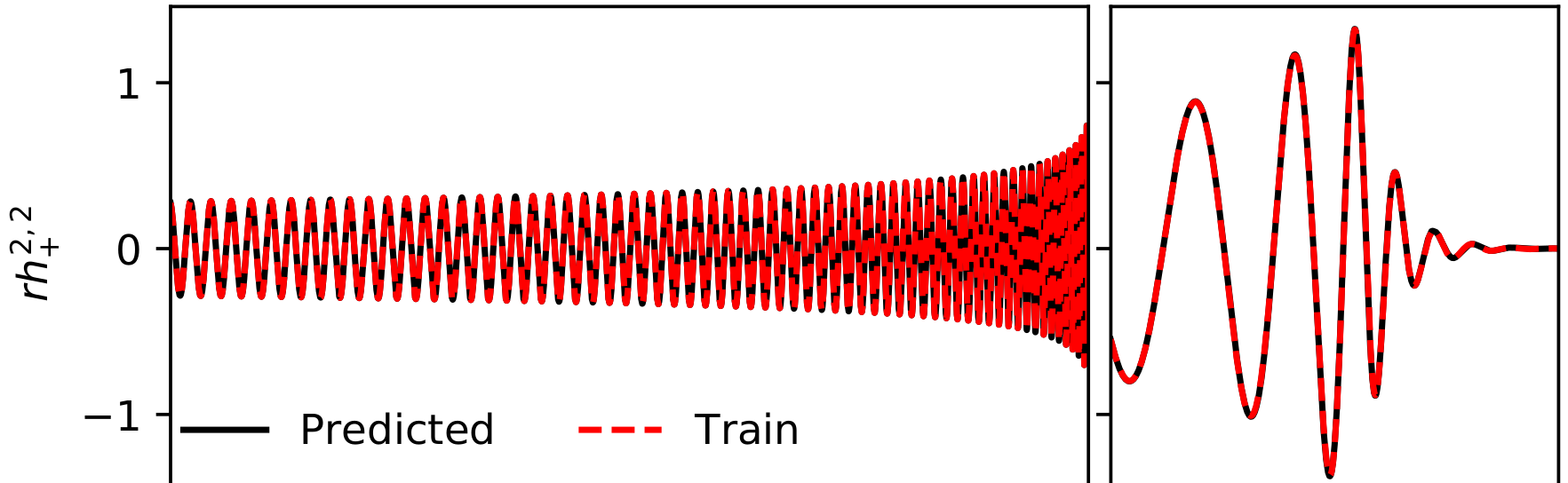
The package builds on the earlier EMRISurrogate package, which is no longer actively maintained.
The “raw” surrogate model is trained on ppBHPT waveform data and is defined by
\[h_{\tt S}(t, \theta, \phi; q, \chi_1) = \sum^{\infty}_{\ell=2} \sum_{m=-\ell}^{\ell} h_{\tt S}^{\ell,m}(t; q, \chi_1) \, {}^{-2}Y_{\ell m}(\theta, \phi) \,,\]where ${}^{-2}Y_{\ell m}$ are the spin-weight $-2$ spherical harmonics, $q = m_1/m_2 \geq 1$ is the mass ratio, and $\chi_1$ is the dimensionless spin of the larger black hole. The surrogate provides fast evaluations of the modes $h_{\tt S}^{\ell,m}$ with $m > 0$; the $m < 0$ modes follow from $h^{\ell,-m} = (-1)^{\ell} \left(h^{\ell,m}\right)^*$.
By default, the package returns rescaled waveform modes,
\[h^{\ell,m}_{\tt S, \alpha}(t ; q, \chi_1) = \alpha_{\ell} \, h^{\ell,m}_{\tt S}\left( t \beta; q, \chi_1 \right) \,,\]where the calibration parameters $\alpha_{\ell}(q,\chi_1)$ and $\beta(q,\chi_1)$ are
tuned to NR simulations. Most users will want the NR-calibrated model. To generate
pure ppBHPT waveforms without any tuning to NR (i.e. $\alpha_{\ell} = \beta = 1$),
pass calibrated=False to generate_surrogate.
| Model | Parameters | Modes | Raw ppBHPT length |
|---|---|---|---|
| BHPTNRSur1dq1e4 | Non-spinning; $2.5 \le q \le 10^4$ | 50 modes up to $\ell=10$ (listed below); modes up to $\ell=5$ are calibrated to NR | $\sim 30{,}500M$ |
| BHPTNRSur2dq1e3 | Aligned spin on the larger black hole; $3 \le q \le 1000$, $-0.8 \le \chi_1 \le 0.8$ | All modes up to $\ell=4$ except (4,1) and the $m=0$ modes, plus their $m<0$ counterparts | $\sim 13{,}500M$ |
The $m>0$ modes of BHPTNRSur1dq1e4 are (2,2), (2,1), (3,1), (3,2), (3,3), (4,2), (4,3), (4,4), (5,3), (5,4), (5,5), (6,4), (6,5), (6,6), (7,5), (7,6), (7,7), (8,6), (8,7), (8,8), (9,7), (9,8), (9,9), (10,8) and (10,9); together with their $m<0$ counterparts this makes 50 modes.
Details of BHPTNRSur1dq1e4 are in Islam et al. (2022) and of BHPTNRSur2dq1e3 in Rink et al. (2024). The predecessor model EMRISur1dq1e4 is not included in this package; it is still available, but deprecated, in EMRISurrogate.
Both models use the total mass $M$ by default (mass_scale='M'). For uncalibrated
waveforms the underlying ppBHPT data use the primary mass $m_1$, so the package
rescales both time and strain by $q/(q+1)$ to return total-mass units. This default
changed in version 0.2.0. To reproduce the earlier behaviour, pass mass_scale='m1'.
That option is only available for uncalibrated geometric-unit waveforms; calibrated and
physical-unit waveforms require mass_scale='M'.
Clone the repository (with its submodule) and install it locally:
git clone https://github.com/BlackHolePerturbationToolkit/BHPTNRSurrogate.git
cd BHPTNRSurrogate
git submodule init
git submodule update
pip install -e .
Runtime dependencies (numpy, scipy, h5py, gwtools and scikit-learn) are installed automatically.
The surrogate data files (BHPTNRSur1dq1e4.h5 and BHPTNRSur2dq1e3.h5) are hosted on
Zenodo. They are downloaded automatically into the
package’s data/ directory the first time you call a model. Alternatively, download them
yourself and place them in BHPTNRSurrogate/data/:
wget https://zenodo.org/records/13340319/BHPTNRSur1dq1e4.h5
wget https://zenodo.org/records/13340319/BHPTNRSur2dq1e3.h5
To use a custom data directory, set the BHPTNR_SURROGATE_DATA_DIR environment variable
before importing the package.
Parts of the tutorial notebooks also need gwsurrogate
(pip install gwsurrogate or conda install -c conda-forge gwsurrogate). You don’t need it
to evaluate the BHPTNRSurrogate models.
Each model is a module with a generate_surrogate function. It returns the time array and
a dictionary of modes keyed by (l, m). Run help(bhptsur.generate_surrogate) for the full
list of options.
import numpy as np
from BHPTNRSurrogate.surrogates import BHPTNRSur1dq1e4 as bhptsur

# NR-calibrated modes in geometric units (t in M, h in rh/M)
t, h = bhptsur.generate_surrogate(q=20)
h22 = h[(2, 2)]

# raw (uncalibrated) ppBHPT waveform
t, h = bhptsur.generate_surrogate(q=20, calibrated=False)

# physical units: total mass in solar masses, distance in Mpc
t, h = bhptsur.generate_surrogate(q=100, M_tot=60, dist_mpc=100)

# evaluated at a point on the sphere, summing all modes up to l = 3
t, h = bhptsur.generate_surrogate(q=18, M_tot=60, dist_mpc=100,
                                  orb_phase=np.pi/3, inclination=np.pi/4,
                                  lmax=3, mode_sum=True)
The spinning model takes the primary spin as spin1:
from BHPTNRSurrogate.surrogates import BHPTNRSur2dq1e3 as bhptsur

t, h = bhptsur.generate_surrogate(q=20, spin1=0.5)
Other useful options include modes (a list of (l, m) modes to return), lmax, and
neg_modes (whether to return the $m<0$ modes; default True). Calibrated and physical
waveforms are always in total-mass units; see Mass convention above.
The repository’s tutorials directory has example notebooks for both models:
Known bugs are recorded in the project issue tracker.
BHPTNRSurrogate is distributed under the MIT License. See the LICENSE file for details.
Ritesh Bachhar, Scott Field, Tousif Islam, Gaurav Khanna, Nur Rifat, Katie Rink, Vijay Varma
If you use BHPTNRSurrogate in your research, please acknowledge the Toolkit:
This work makes use of the Black Hole Perturbation Toolkit.
BHPTNRSurrogate also requests the following citations:
@article{Islam:2022laz,
    author = "Islam, Tousif and Field, Scott E. and Hughes, Scott A. and Khanna, Gaurav and Varma, Vijay and Giesler, Matthew and Scheel, Mark A. and Kidder, Lawrence E. and Pfeiffer, Harald P.",
    title = "{Surrogate model for gravitational wave signals from nonspinning, comparable-to large-mass-ratio black hole binaries built on black hole perturbation theory waveforms calibrated to numerical relativity}",
    eprint = "2204.01972",
    archivePrefix = "arXiv",
    primaryClass = "gr-qc",
    doi = "10.1103/PhysRevD.106.104025",
    journal = "Phys. Rev. D",
    volume = "106",
    number = "10",
    pages = "104025",
    year = "2022"
}@article{Rink:2024swg,
author = "Rink, Katie and Bachhar, Ritesh and Islam, Tousif and Rifat, Nur E. M. and Gonzalez-Quesada, Kevin and Field, Scott E. and Khanna, Gaurav and Hughes, Scott A. and Varma, Vijay",
title = "{Gravitational wave surrogate model for spinning, intermediate mass ratio binaries based on perturbation theory and numerical relativity}",
eprint = "2407.18319",
archivePrefix = "arXiv",
primaryClass = "gr-qc",
doi = "10.1103/PhysRevD.110.124069",
journal = "Phys. Rev. D",
volume = "110",
number = "12",
pages = "124069",
year = "2024"
}@article{Rifat:2019ltp,
author = "Rifat, Nur E. M. and Field, Scott E. and Khanna, Gaurav and Varma, Vijay",
title = "{Surrogate model for gravitational wave signals from comparable and large-mass-ratio black hole binaries}",
eprint = "1910.10473",
archivePrefix = "arXiv",
primaryClass = "gr-qc",
doi = "10.1103/PhysRevD.101.081502",
journal = "Phys. Rev. D",
volume = "101",
number = "8",
pages = "081502",
year = "2020"
}See how to cite for further guidance.