SelfForce-1D
FortranEffective-source EMRI simulation infrastructure in the time domain
Self-force & inspirals
Self-force inspirals via near-identity transformed equations of motion
Fast Self-Forced Inspirals is a C++ code that rapidly computes inspiral trajectories, and the associated waveforms, for eccentric small-mass-ratio inspirals into a Schwarzschild black hole. The inspirals include the local (first-order) gravitational self-force.
The speed comes from integrating the near-identity transformed (NIT) equations of motion. A near-identity transformation removes the dependence on the orbital phases from the self-forced equations of motion, so they can be integrated with large time steps while retaining the secular and oscillatory self-force effects. A NIT inspiral is computed in milliseconds, whereas integrating the full self-forced equations of motion takes seconds to hours depending on the mass ratio. The method is described in van de Meent & Warburton (2018).
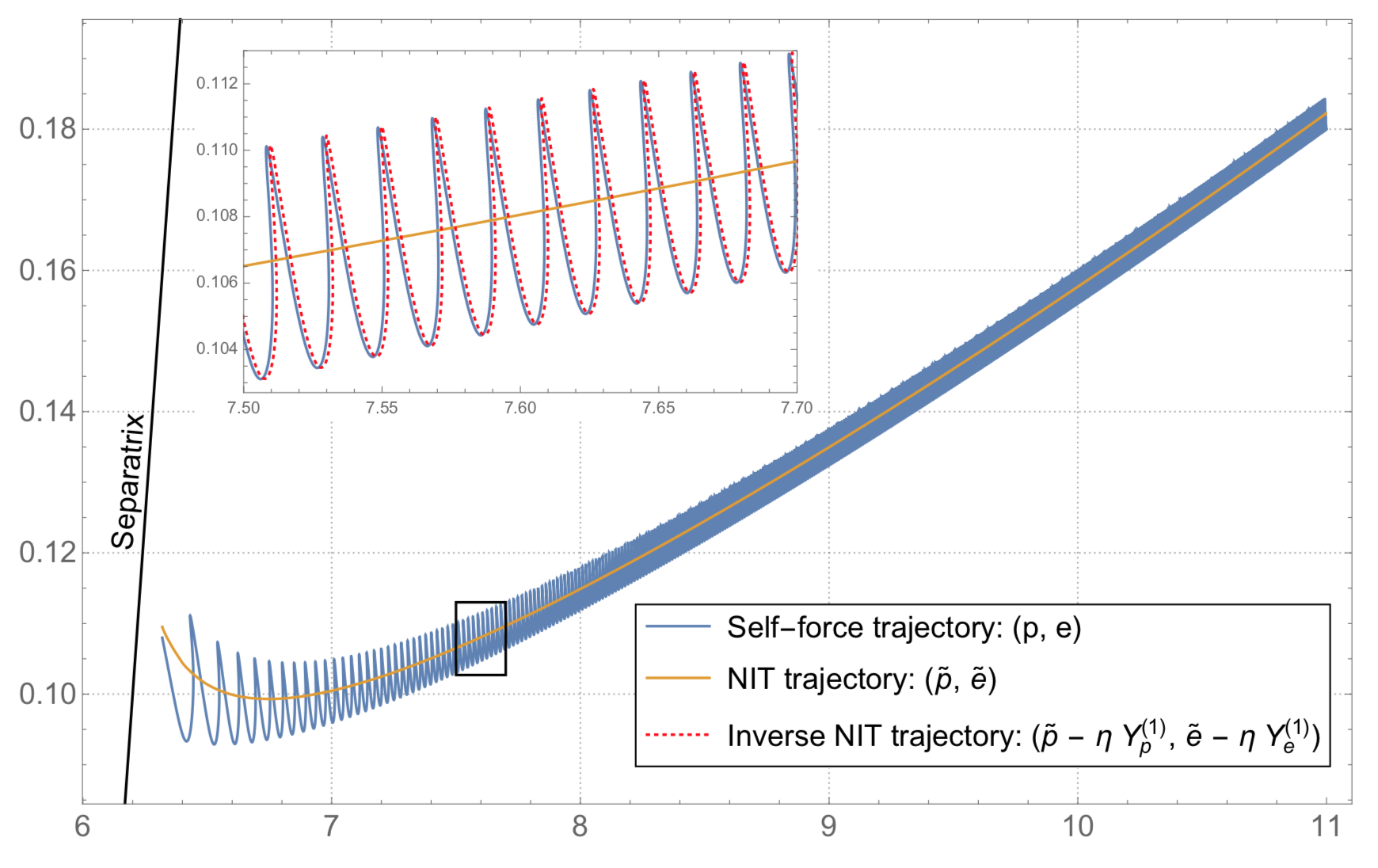
The NIT inspiral model is built on the self-force model of N. Warburton et al.. As a result it is only valid for Schwarzschild inspirals with initial parameters $0 \le e < 0.2$ and $6 + 2e < p < 12$. Extensions using the self-force model of T. Osburn et al., and to generic inspirals in Kerr spacetime, were planned but are not part of the current code.
The code depends on:
libconfig++)g++)Clone the repository and build with scons in the top-level directory:
git clone https://github.com/BlackHolePerturbationToolkit/Fast_Self-Forced_Inspirals.git
cd Fast_Self-Forced_Inspirals
scons
This creates the executable NIT_inspiral in the top-level directory. If your libraries
are in non-standard locations, edit src/SConscript.
Run ./NIT_inspiral from the top-level directory: it reads config/parameters.cfg and the
self-force model in GSF_model_data/, and writes to data/ and output/. Running it
without arguments prints the list of options.
Before computing any NIT inspiral, compute the averaged forcing functions. This is a one-off, two-step process:
./NIT_inspiral -d    # decompose the self-force into Fourier modes
./NIT_inspiral -c    # compute the averaged forcing functions from the Fourier coefficients
Then compute an inspiral from initial semi-latus rectum p0, eccentricity e0 and (small)
mass ratio q. It runs from the initial parameters until the onset of plunge near the
separatrix:
./NIT_inspiral -n p0 e0 q    # NIT inspiral (milliseconds)
./NIT_inspiral -f p0 e0 q    # full self-forced inspiral (seconds to hours, depending on q)
To compute the waveform for an inspiral, first compute the inspiral itself with one of the commands above, then run
./NIT_inspiral -w p0 e0 q -n    # waveform for the NIT inspiral
./NIT_inspiral -w p0 e0 q -f    # waveform for the full self-forced inspiral
The waveform settings are read from config/parameters.cfg:
| Setting | Meaning |
|---|---|
M_solar |
mass of the primary in solar masses |
Deltat_sec |
waveform sampling time step in seconds |
i_max |
number of time steps in the waveform |
Dense_output |
1 to output the trajectory at regular intervals in the orbital phase $\chi$; 0 to output at every step of the adaptive integrator |
n_per_orbit |
with dense output, the number of outputs per $2\pi$ of $\chi$ |
All output is plain text in output/, with the run parameters in the file name, e.g.
output/Inspiral_NIT_p<p0>_e<e0>_q<q>.dat and output/Waveform_NIT_p<p0>_e<e0>_q<q>.dat
(Full in place of NIT for full inspirals).
chi p e xi t phi for NIT inspirals, or
chi p e chi0 t phi for full inspirals. Here chi is the orbital phase variable used to parametrise the inspiral, p and e are
the semi-latus rectum and eccentricity, and t and phi are the time and azimuthal angle.t h+ h×, with t in seconds.Compute a NIT inspiral and its waveform for $p_0 = 10$, $e_0 = 0.1$ and $q = 10^{-5}$:
./NIT_inspiral -d
./NIT_inspiral -c
./NIT_inspiral -n 10 0.1 1e-5
./NIT_inspiral -w 10 0.1 1e-5 -n
The code is licensed under the GPLv3. See the LICENSE file for details.
Niels Warburton, Maarten van de Meent
If you use Fast Self-Forced Inspirals in your research, please acknowledge the Toolkit:
This work makes use of the Black Hole Perturbation Toolkit.
Fast Self-Forced Inspirals also requests the following citation:
@article{VanDeMeent:2018cgn,
    author = "Van De Meent, Maarten and Warburton, Niels",
    title = "{Fast Self-forced Inspirals}",
    eprint = "1802.05281",
    archivePrefix = "arXiv",
    primaryClass = "gr-qc",
    doi = "10.1088/1361-6382/aac8ce",
    journal = "Class. Quant. Grav.",
    volume = "35",
    number = "14",
    pages = "144003",
    year = "2018"
}
See how to cite for further guidance.